
Every year around booster time, some version of this conversation happens in exam rooms across the country: “Does my dog really need this shot again, or can we just test for it?” It’s a fair question. Titer testing sounds like the savvy, science-forward alternative to routine revaccination — check the antibody levels, skip the needle if they’re high enough, save some money. In practice, the math is messier than that. Titer testing isn’t free, it isn’t always cheaper, and it doesn’t replace every vaccine on your pet’s schedule. Here’s how the costs actually break down so you can talk to your vet with real numbers instead of a vague hunch that testing must be the “budget” option.
What titer testing measures and how it differs from a standard booster visit
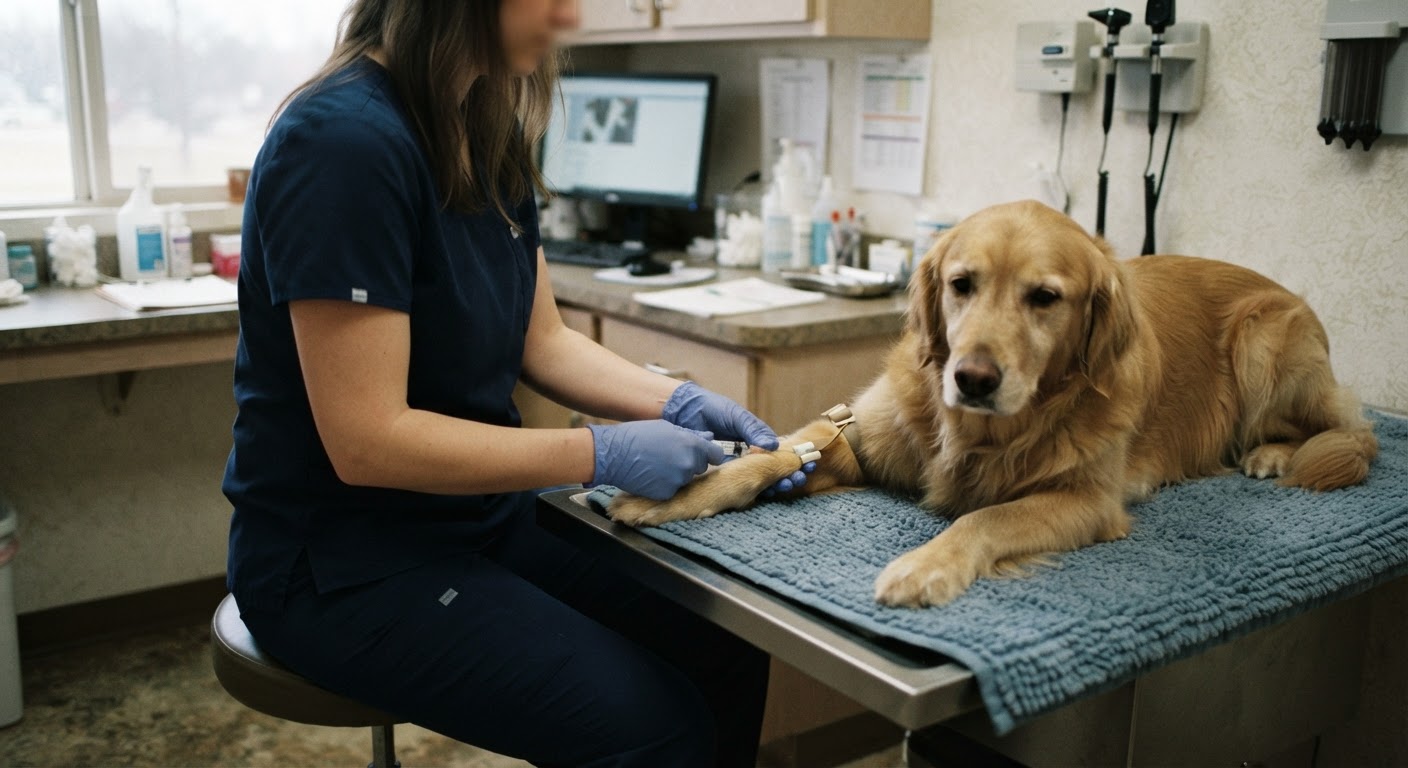
A titer test is a blood draw that measures the level of specific antibodies circulating in your pet’s system for a given disease — most commonly canine distemper and parvovirus, or feline distemper (panleukopenia). The idea is that if antibody levels are still high enough, your pet’s immune system likely retains protective memory from a past vaccine, and a booster may not add much benefit right now.
A standard booster visit, by contrast, doesn’t try to measure existing immunity at all. It just re-administers the vaccine on a schedule, on the assumption that immunity fades over time and a refresher is the safer default. Both approaches involve a clinic visit, but a titer test adds a diagnostic step: blood is drawn, sent to a lab (or run in-house, depending on the clinic), and results take anywhere from same-day to about a week, depending on which lab processes it.
It’s worth being clear-eyed about what a titer result actually tells you and what it doesn’t. A “positive” or “protective” titer is a reasonable proxy for immunity against certain diseases, but it isn’t a guarantee, and vets differ on how they interpret borderline results. Titer testing also doesn’t work the same way for every vaccine — it’s well established for some diseases and considered unreliable or simply not accepted as a substitute for others. That distinction matters a lot for your wallet, which we’ll get to.
Typical price ranges for titer tests vs routine vaccinations at general practice clinics
At a general practice clinic, a single booster vaccine is usually one of the cheaper things you’ll pay for at a vet visit. Combination vaccines (like the DHPP for dogs or FVRCP for cats) are often bundled and priced modestly, especially compared to everything else on a wellness invoice. A titer test, on the other hand, is a lab-based diagnostic, and it’s priced more like bloodwork than like a shot.
Generally speaking, a titer test for a single disease tends to cost noticeably more than the vaccine it’s meant to replace. If you’re titer-testing for more than one disease — say, both distemper and parvo — you’re often paying per antibody measured, not one flat fee for “the titer test.” That can add up quickly, especially if the clinic sends samples to an outside reference lab rather than running them in-house, since outside lab fees typically get added on top of the office visit charge.
Then there’s the exam fee itself. Whether you’re getting a booster or a titer draw, most clinics still charge for the office visit, so that part of the cost is roughly a wash between the two options. The real cost difference lives in what happens after the exam room: a cheap vaccine syringe versus a lab requisition that has to be processed, interpreted, and reported back to you.
None of this means titer testing is a bad financial decision by default — it depends heavily on your pet’s situation, which we’ll walk through later. But if your primary goal is minimizing this year’s vet bill, going in assuming a titer test is the frugal choice can backfire.
Which vaccines are commonly titer-tested (rabies exceptions and legal requirements to know)
Titer testing is most commonly used for core vaccines where long-lasting immunity is well documented — distemper and parvovirus in dogs, and panleukopenia in cats, in particular. These are the vaccines where research has given vets more confidence that a strong antibody titer really does correlate with protection, which is why some owners and vets use titers to space out revaccination intervals for these specific diseases.
Rabies is a different story, and this is the piece that trips people up. Rabies vaccination isn’t just a medical decision — it’s a legal one. Most states and many municipalities require rabies vaccination on a set schedule regardless of what a titer test shows, because rabies is a public health matter, not just an individual pet health matter. A high rabies titer does not exempt your pet from the legal vaccination requirement in the vast majority of jurisdictions. There are narrow circumstances, sometimes involving specific medical exemptions granted by a veterinarian for pets with documented health issues, where alternative arrangements might be discussed — but that’s a conversation to have directly with your vet and your local animal control authority, not a decision to make based on a titer result alone. If you’re considering titer testing partly to avoid a rabies booster, it’s worth confirming your local requirements before you spend money on a test that won’t change your legal obligation.
Other non-core vaccines — things like leptospirosis, bordetella (kennel cough), or feline leukemia — generally aren’t titer-tested in routine practice. Immunity for these tends to be shorter-lived or less reliably measured by a simple antibody titer, so vets typically don’t offer titer testing as an alternative for them. If your dog needs a bordetella vaccine for daycare or a boarding facility, a titer test isn’t going to satisfy that requirement anyway, since most facilities want documented recent vaccination, not a lab report.
Hidden costs: follow-up vaccines if titers come back low, lab fees, and repeat testing
This is where the “titer testing saves money” assumption tends to fall apart, and it’s the part worth budgeting for before you commit to the test rather than after.
First, there’s the possibility that the titer comes back low or inconclusive. When that happens, most vets recommend giving the booster anyway — which means you’ve now paid for the titer test and the vaccine, rather than just the vaccine. If you were hoping to skip a cost, a low titer result turns this into the more expensive path, not the cheaper one.
Second, outside lab fees are easy to underestimate. Some general practice clinics run titer tests in-house with a quick turnaround and a simpler fee structure. Others send samples out to a reference laboratory, and those results come back with an additional lab processing charge that isn’t always itemized clearly on the initial estimate you’re given. It’s reasonable to ask your vet’s office directly: is this titer run in-house, or sent out, and what’s the total expected cost including any lab fees, before you agree to the test.
Third, titer testing isn’t a one-time decision if you’re using it as an ongoing strategy instead of a fixed revaccination schedule. If you titer-test annually instead of vaccinating on a three-year schedule, for example, you could end up paying for two or three titer tests in the time it would have taken to just get one booster — and if any of those titers come back low, you’re paying for the vaccine on top of that. Over several years, a titer-based approach can end up costing more in cumulative testing fees than a standard vaccination schedule would have, even though each individual booster is “skipped” in the years the titer looks fine. This doesn’t mean titer testing is always the expensive route — it depends on how often you test and how your particular pet’s immunity holds up — but it’s a real possibility worth running the numbers on rather than assuming testing is inherently the money-saving choice.
How wellness plans and insurance riders treat titer testing versus vaccination
If you have a wellness plan add-on through a pet insurance provider, or you’re considering one, it’s worth checking the fine print on how titer testing is categorized, because it isn’t always treated the same as a vaccine.
Standard wellness plans are usually built around a fixed list of preventive services — vaccines, fecal exams, heartworm tests, and similar routine items — each with its own reimbursement cap or flat allowance. Vaccines are almost always on that list. Titer testing sometimes is and sometimes isn’t, depending on the specific plan and provider. Some wellness add-ons will reimburse a titer test as a diagnostic under a general “lab work” allowance rather than under “vaccines,” which can mean a different reimbursement amount, or none at all if that category is already used up for other bloodwork that year.
It’s also worth remembering that wellness plans are a separate product from your core accident-and-illness insurance policy, and preventive care like vaccines and titers is routine, planned, budgetable spending — not the kind of unpredictable event that accident-and-illness coverage is really designed to protect you against. Don’t assume that because you have pet insurance, your titer test is automatically covered somewhere in the policy. Call the provider or read the plan documents and ask specifically: is titer testing listed as a covered preventive service, and if so, under which reimbursement category and at what cap? Getting a clear answer before you schedule the test avoids an unpleasant surprise on the reimbursement side.
A simple framework for deciding whether titer testing makes financial sense for your pet’s age and health history
Given all of that, how do you actually decide? A few practical questions can help you and your vet sort this out without guesswork.
Start with your pet’s vaccination history. Titer testing tends to make the most financial sense for adult pets with a well-documented history of prior core vaccinations — there’s more reason to expect a meaningful antibody level to measure. For puppies and kittens still building initial immunity, titer testing generally isn’t a substitute for the initial vaccine series at all, so it’s not really a cost comparison in that stage of life.
Consider your pet’s age and health status next. Older pets, or pets with health conditions that make vaccination riskier or that make your vet want to minimize unnecessary interventions, are often the strongest candidates for titer testing as a genuine medical and financial trade-off — you may be paying for the test specifically to avoid an unnecessary vaccine, not primarily to save money, and that’s a reasonable reason on its own.
Factor in how many diseases you’d actually be titer-testing for. If you’re only interested in checking one core vaccine’s status, the cost comparison is more straightforward. If you’re tempted to titer-test everything on the schedule, remember that per-antibody lab fees add up, and rabies isn’t going to be part of that equation legally anyway.
Ask your vet directly what happens if the titer comes back low — will they recommend the booster on the spot, or wait and retest? Knowing this in advance lets you budget for the worst-case cost of the test-then-maybe-vaccinate path, rather than being caught off guard.
Finally, weigh how often you’d realistically repeat testing. A one-time titer check to satisfy your own curiosity or to inform a single vaccination decision is a very different cost than committing to annual titer testing indefinitely as your ongoing vaccination strategy.
There’s no universal right answer here — it genuinely depends on your specific pet, your vet’s clinical judgment, and your local legal requirements. But going into the conversation with a clear sense of what a titer test actually costs, what it can and can’t replace, and what happens if the result isn’t