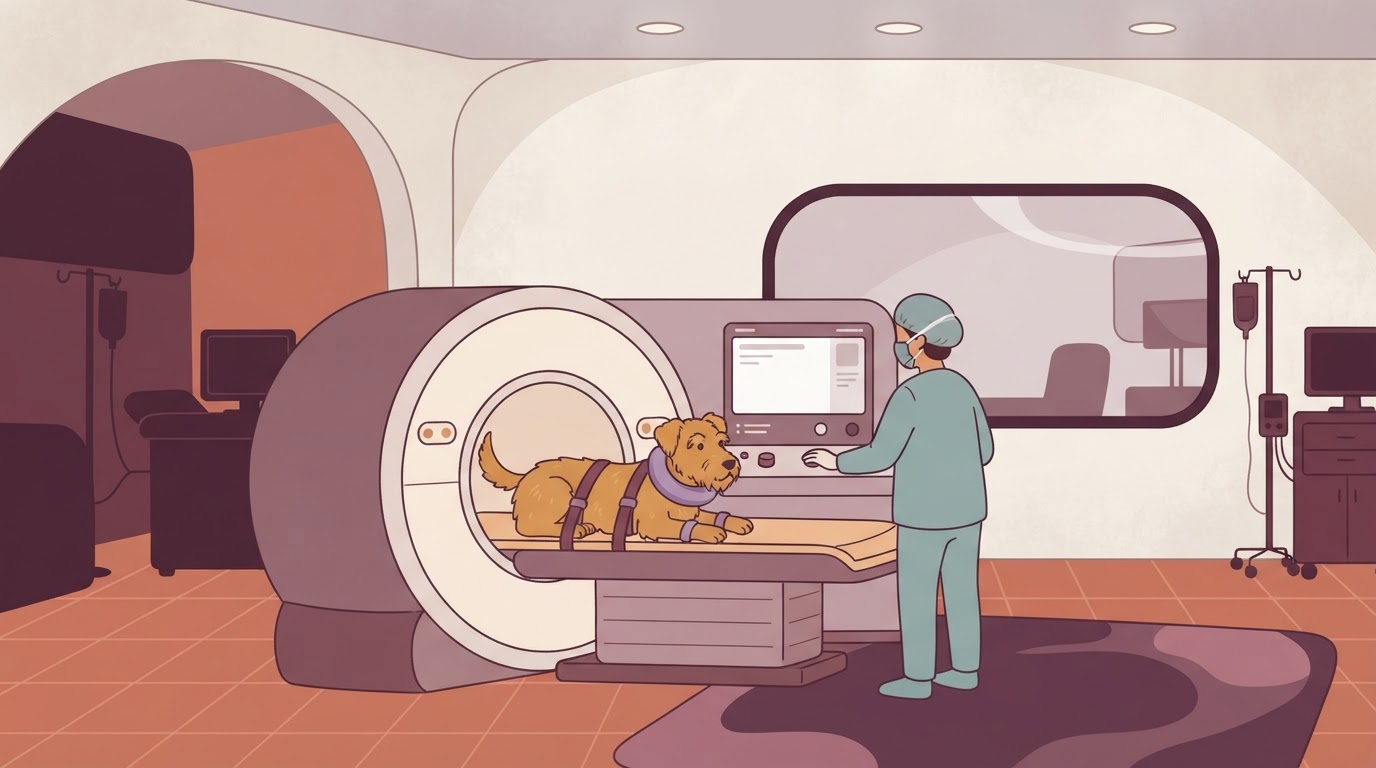
Your vet says the words “I think we need an MRI” or “let’s get a CT scan to see what’s going on,” and suddenly your mind jumps to a number. You’ve probably heard advanced imaging for pets can cost as much as a used car repair, or more. Before you panic or start Googling emergency loans, it helps to understand why these scans cost what they cost, and what typically happens between hearing that recommendation and getting the results back.
Why advanced imaging costs so much more than an X-ray or basic ultrasound
A regular X-ray at your vet’s office is usually a same-day, walk-in-and-walk-out affair. Your pet holds still (or is gently restrained) for a few seconds, the machine takes the image, and your vet looks at it right there. A basic abdominal ultrasound might take a bit longer, but it’s often still done awake, with a technician sliding a probe over a shaved patch of belly.
MRI, CT, and more detailed ultrasound studies are a different category of medicine entirely. These machines don’t just take a picture, they build a three-dimensional map of soft tissue, bone, or organs in a level of detail that basic imaging simply can’t match. That detail is exactly why your vet wants it, especially for things like spinal problems, certain tumors, or subtle issues inside the skull or chest that an X-ray would miss entirely.
But getting that detail requires equipment that costs a genuine fortune to buy, house, and maintain, plus a team of people trained to run it safely. A pet can’t be told to hold their breath or lie still for twenty minutes on command, so most MRI and CT scans require general anesthesia. That single fact changes the whole cost structure, because now you’re not just paying for machine time, you’re paying for a full anesthesia team, monitoring equipment, and recovery care, on top of the imaging itself.
There’s also the matter of who reads the scan. A basic X-ray gets interpreted by your regular vet, who has training in it but isn’t a specialist. Advanced imaging is usually sent off to a board-certified veterinary radiologist, someone who has done years of extra training specifically to interpret these complex studies. That expertise doesn’t come cheap, and it’s a separate charge on top of everything else.
Typical price ranges for MRI, CT, and ultrasound at general practices vs specialty centers
Prices for advanced imaging vary a lot depending on where you live, what kind of facility you’re at, and what body part is being scanned. As a general shape of things, here’s how the categories tend to stack up against each other.
A detailed ultrasound, especially one done by a specialist rather than a general practice vet, tends to be the least expensive of the three, though it’s still noticeably pricier than a basic scan. It usually doesn’t require full anesthesia, just sedation in many cases, which helps keep the cost down compared to MRI or CT.
CT scans generally fall in the middle. They’re faster than MRIs, sometimes only a few minutes of actual scan time, which can mean less anesthesia time and a somewhat lower bill, though this isn’t a hard rule. CT is often the go-to for looking at bone, chest, and certain abdominal issues.
MRI tends to sit at the top of the price range. The scan itself takes longer, sometimes forty-five minutes to over an hour, which means more anesthesia time and more monitoring. MRI is especially common for brain, spinal cord, and certain soft tissue issues where the level of detail really matters.
Where you get the scan matters just as much as which scan it is. A general practice vet doesn’t own an MRI or CT machine, these are typically only available at specialty or referral hospitals, university veterinary teaching hospitals, or dedicated imaging centers. Your regular vet will refer you out for the scan itself, even if they’re managing the rest of your pet’s care. Specialty hospitals in larger metro areas tend to charge more than the same service in a smaller city, simply because their overhead is higher. Emergency or after-hours imaging, if your pet needs a scan urgently rather than as a scheduled appointment, usually costs more too.
It’s worth calling around, when you have the luxury of time, because prices for the same type of scan can differ meaningfully between facilities in the same metro area. That said, when a vet is recommending imaging because your pet is actively sick or in pain, you often don’t have the luxury of shopping three different centers. This is exactly why planning ahead matters more than trying to comparison shop in the moment.
What drives the cost: anesthesia, specialist read fees, and facility charges
It helps to think of an advanced imaging bill as several separate line items stacked together, rather than one flat fee for “the scan.” Understanding these pieces makes the total less mysterious and helps you ask better questions when you get an estimate.
Anesthesia is usually one of the biggest chunks. This isn’t just the drug itself, it’s pre-anesthetic bloodwork to make sure your pet is a safe candidate, an IV catheter, a trained technician monitoring vital signs throughout the procedure, and recovery monitoring afterward until your pet is alert and stable. For pets with existing health conditions, anesthesia risk assessment and monitoring can be more involved, which adds to the cost.
The facility fee covers the machine time itself, which reflects the enormous cost of purchasing and maintaining an MRI or CT unit, plus the staff running it. This is the part most people picture when they think of “the scan,” but it’s often not even half the total bill.
The radiologist’s read fee is a separate charge for the specialist who interprets the images and writes up a report. This might be billed by the imaging center directly or come as a separate invoice, depending on how the facility is set up. Either way, it’s a real cost that’s easy to overlook when you’re mentally budgeting just for “the scan.”
Beyond those three big pieces, you may also see charges for IV fluids, contrast dye if the study requires it, additional bloodwork, sedation reversal drugs, or an overnight stay if your pet needs monitoring after anesthesia. Some facilities bundle these into a package price for the imaging, others itemize everything separately. When you get an estimate, it’s worth asking whether it’s an all-in number or whether extras are likely to be added on.
How insurance coverage for imaging usually works, including any waiting periods or sub-limits
If your pet has an accident and illness insurance policy, advanced imaging is generally covered as a diagnostic tool when it’s used to investigate a covered condition, the same way bloodwork or X-rays would be. But there are a few structural things about how pet insurance works that are worth understanding before you’re relying on it.
First, waiting periods. Every policy has a window after you first sign up, often just a few days for accidents but commonly two weeks or more for illnesses, during which claims aren’t covered yet. If your pet develops a condition during that window, imaging related to it likely won’t be reimbursed, even though you’re paying premiums. This is one of the biggest reasons to get a policy in place well before you think you’ll need it, not after your vet already mentions something concerning.
Second, pre-existing conditions. If your pet has already been diagnosed with, or shown symptoms of, a condition before you enrolled or before the waiting period ended, most insurers will exclude that condition and anything related to it going forward, including any imaging done to monitor or investigate it. This is standard across the industry, not a quirk of one company, so it’s worth understanding rather than being surprised by.
Third, how your policy structures reimbursement matters a lot for a bill this size. Most modern accident and illness plans reimburse a percentage of the total vet bill after your deductible, rather than paying a fixed dollar amount per diagnostic test. That structure tends to be friendlier for expensive one-time procedures like imaging, because there’s no separate cap specifically on scans, they’re just part of the larger claim for that illness or injury. Older or more limited policies, and some add-on wellness plans, sometimes use per-incident or per-category caps instead, which can leave you covering more of an imaging bill out of pocket if the sub-limit is lower than the actual cost. When you’re comparing policies, it’s worth specifically checking whether diagnostic imaging falls under the general reimbursement percentage or whether there’s a separate cap just for it.
Annual coverage limits also matter here, because a single MRI or CT scan can eat up a meaningful chunk of a low annual limit in one visit, especially if there’s follow-up treatment afterward. If you’re choosing a policy, it’s worth thinking about whether the annual limit feels comfortable relative to the kind of bill an unexpected diagnosis and imaging workup could generate, not just the monthly premium.
Finally, remember that with most pet insurance, you typically pay the vet bill upfront and get reimbursed after submitting a claim, rather than the insurer paying the clinic directly. That means even with good coverage, you need to be able to cover the cost at the time of service and wait for reimbursement, which is its own budgeting consideration separate from whether the imaging is covered at all.
Questions to ask before agreeing to imaging so there are no surprises
When your vet recommends an MRI, CT, or detailed ultrasound, it’s completely reasonable to pause and ask questions before signing off, even when you’re worried about your pet and want answers fast. A good vet won’t be offended by this, it’s a normal part of informed consent for a costly procedure.
Ask for a written estimate that breaks down the imaging facility fee, anesthesia, the radiologist’s read, and any extras like bloodwork or contrast dye, so you know whether the number you’re seeing is the full picture or just a starting point. Ask whether the estimate is for the imaging center specifically, since your vet’s office is referring you elsewhere, and whether that facility bills separately for the specialist’s report.
Ask what happens if the scan reveals something requiring immediate treatment, whether that’s a same-day decision or something you’ll have time to think through afterward, since that affects both your emotional and financial planning. Ask whether sedation alone might be sufficient instead of full anesthesia, and if not, why the fuller anesthesia protocol is needed for this particular scan.
If you have pet insurance, ask your vet’s office for an itemized invoice format, since insurers typically want detailed documentation to process a claim smoothly. It’s also worth calling your insurer ahead of a scheduled scan, if you have the time to do so, to confirm the condition isn’t excluded and to understand roughly what percentage of the bill you can expect back and how the deductible applies.
And if cost is a serious concern, it’s fair to ask your vet directly whether a payment plan, a less expensive imaging option, or a phased approach, starting with less costly diagnostics before moving to MRI or CT, might be reasonable given your pet’s specific situation. Vets deal with budget conversations regularly, and most would rather work with you on a plan than have you skip needed diagnostics entirely.