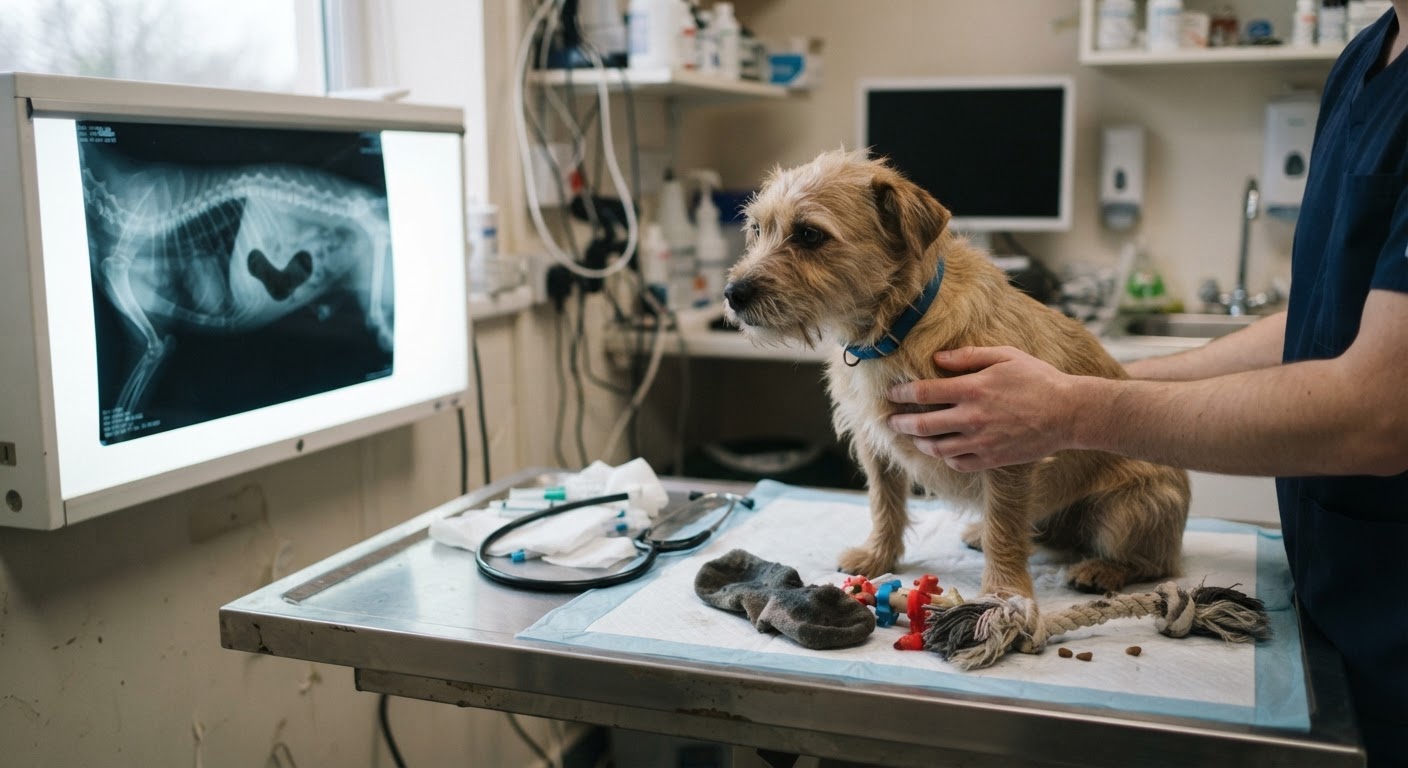

Why Foreign Body Ingestion Is One of the Most Common Emergency Surgeries for Dogs
If you’ve ever watched your dog eyeball a sock, a corn cob, or the squeaky insert of a toy with a little too much interest, you already know the anxiety. Dogs explore the world with their mouths, and that curiosity doesn’t always stop at “taste and spit out.” Puppies and young, high-energy dogs are especially prone to swallowing things they shouldn’t, but plenty of older, otherwise sensible dogs surprise their owners too, usually during a moment of boredom, excitement, or an unattended kitchen counter.
Vets sometimes group these cases under the term “foreign body obstruction,” and it’s one of the most frequently seen true emergencies in general practice and ER settings. The reason it comes up so often isn’t that dogs are careless eaters exactly, it’s that so many everyday household items are the wrong shape, size, or material to pass safely through a dog’s digestive tract. Socks and underwear are classic offenders because fabric doesn’t break down and tends to bunch up. Corn cobs are notorious because they’re dense, don’t compress, and are just the wrong size for a lot of dogs’ intestines. Squeaky toy parts, bones, string, rocks, and even hair ties show up constantly in vet case notes.
What makes this category of emergency worth understanding ahead of time is the combination of how common it is and how quickly it can escalate. A swallowed object that seems minor at first can turn into a genuine surgical emergency within a day or two, and the cost difference between “caught early” and “caught late” is often significant. Knowing the general shape of what this kind of care costs, and why, helps you make faster, calmer decisions if it ever happens to your dog.
Step-by-Step Cost Breakdown: From the First X-Ray to the Recovery Cone
Foreign body cases rarely involve just one bill. They usually unfold in stages, and each stage adds its own cost. Here’s the general sequence most dogs go through, along with what tends to drive the price at each step.
The initial exam
This is where the visit starts, whether at your regular vet or an emergency clinic. The vet will ask about what was swallowed (if you know), when, and what symptoms you’re seeing. A basic physical exam and consultation fee is the smallest part of the overall bill, but it sets everything else in motion. Emergency and after-hours clinics typically charge more for this step than a daytime appointment at your regular vet, simply because of staffing and overhead.
Imaging
X-rays are usually the first diagnostic tool because they’re fast and relatively affordable compared to what comes next. Some objects, like certain toys, bones, or metal, show up clearly on X-ray. Others, especially fabric, wood, or certain plastics, are harder to see and may require a second look, contrast X-rays, or an ultrasound to confirm what’s going on and where it’s located. Each additional imaging step adds to the bill, and multiple rounds of imaging aren’t unusual if the first set is inconclusive.
Inducing vomiting
If the object was swallowed very recently and it’s still sitting in the stomach, some vets will try to induce vomiting as a first-line, lower-cost approach before considering anything more invasive. This only works in a narrow window of time and only for certain types of objects, since some things (like sharp items, batteries, or already-lodged objects) make vomiting a bad idea rather than a solution. This step is far cheaper than surgery, but it’s not something to rely on or attempt at home. It’s also not always appropriate, which is part of why the vet exam and imaging happen first.
Endoscopy versus surgery
If the object is still in the stomach and hasn’t moved into the intestines, and if it’s a shape and size that allows it, some vets can retrieve it using an endoscope, a thin camera and grasping tool passed down the throat under sedation. This avoids opening the abdomen, generally means a shorter recovery, and tends to cost less than surgery, though it still requires anesthesia and specialized equipment that not every clinic has on hand.
If the object has moved into the intestines, if it’s too large or oddly shaped to retrieve with an endoscope, or if there’s any sign of a blockage or tissue damage, traditional surgery becomes necessary. This means general anesthesia, an incision into the abdomen, removal of the object, and, in more serious cases, removing damaged sections of the intestine or stomach lining. Surgery is the most expensive point in this whole process, and the price climbs further if the surgeon needs to remove and reconnect a piece of bowel rather than simply retrieving the object.
Hospitalization
After either endoscopy or surgery, most dogs stay for observation, IV fluids, and pain management for at least one night, sometimes several. This includes monitoring for the two big post-op concerns: infection and whether the digestive tract is healing and functioning normally again. Longer stays mean higher costs, and dogs who had intestinal surgery generally need more monitoring time than dogs who had a straightforward endoscopic retrieval.
Aftercare
Once home, expect a course of pain medication, possibly antibiotics, a bland or prescription recovery diet, a follow-up exam to check healing, and of course the recovery cone or alternative to keep your dog from bothering the incision site. These costs are modest compared to the surgery itself, but they add up, especially if a follow-up visit reveals a complication that needs additional treatment.
How Costs Shift Depending on Where the Object Lodges and Whether Complications Occur
Not all foreign body cases cost the same, and where the object ends up matters almost as much as what it is. An object sitting in the stomach is generally the best-case scenario. It’s more accessible, more likely to be a candidate for either inducing vomiting or endoscopic retrieval, and less likely to have caused tissue damage yet.
Once an object moves into the intestines, the situation typically becomes more serious and more expensive. Intestines are narrower and more delicate than the stomach, so objects can get stuck, cut off blood flow to the surrounding tissue, or cause a perforation (a tear in the intestinal wall). A perforation is a much bigger deal than a straightforward blockage because it can lead to infection inside the abdominal cavity, which requires more aggressive surgery, longer hospitalization, and a more intensive recovery. This is one of the main reasons vets push for prompt evaluation rather than a “wait and see” approach when there’s a real reason to suspect a swallowed object.
Other complications that drive costs up include dogs who arrive already dehydrated or in shock from prolonged vomiting, dogs who need blood work and additional monitoring because of how sick they’ve become, and cases where part of the intestine has to be removed rather than simply opened and cleared. Each of these adds specialists, supplies, time, and monitoring to the bill. The honest takeaway here is that the cost of foreign body surgery isn’t really about the surgery fee in isolation, it’s about how long the object went unaddressed and what that delay did to the surrounding tissue.
What Insurance Typically Covers Here Versus What Owners Still Pay Out of Pocket
Foreign body ingestion is generally treated as an accident under most pet insurance policies, not an illness, which matters because accident coverage often has a different deductible and waiting period structure than illness coverage. If your policy is active and the ingestion isn’t tied to a pre-existing condition, this type of surgery is usually one of the more straightforwardly covered scenarios in pet insurance, precisely because it’s common and clearly accidental.
That said, coverage almost never means “everything is paid for.” Here’s what to expect. Your deductible applies first, whether that’s an annual deductible or a per-incident one, depending on your plan. After that, most plans reimburse a percentage of the covered costs, commonly somewhere in the range of 70 to 90 percent depending on the plan you chose, with the rest coming out of your pocket. Annual or per-incident payout caps can also come into play if your plan has them, which matters for the more expensive intestinal surgery cases.
A few things commonly aren’t covered no matter which plan you have. Exam fees are sometimes excluded or only partially covered depending on the insurer. Anything related to a pre-existing condition won’t be covered, though foreign body cases usually aren’t pre-existing unless your dog has a documented history of repeatedly swallowing objects, which some insurers do flag. Elective add-ons like extended boarding beyond medical necessity, or upgraded recovery products, are also typically on you. And if your policy has a waiting period for accident coverage that hadn’t yet elapsed when the ingestion happened, you’ll be paying the full cost out of pocket regardless of your plan’s usual reimbursement rate.
The practical point here is timing. Pet insurance is only useful for a scenario like this if it’s already in place and past its waiting period before the emergency happens. It’s not something you can add the week your dog starts eyeing the laundry basket.
Practical Ways to Reduce Risk and Cost Before It Happens
A lot of foreign body emergencies are genuinely preventable with a bit of home-proofing, especially once you know your own dog’s habits and weaknesses.
Start with an honest inventory of what’s within reach. Laundry left on the floor, trash cans without secure lids, kids’ small toys, hair ties, and food scraps like corn cobs, peach pits, or bones are some of the most common culprits. If your dog is a known chewer or has ever swall