What separates an urgent care vet clinic from a 24-hour emergency hospital
When your dog won’t stop limping on a Saturday afternoon or your cat throws up for the third time in an hour, the panic response is often the same: get to a vet, any vet, right now. But “any vet” isn’t really one category anymore. Over the past decade, a middle tier of care has grown up between the regular daytime clinic and the full emergency hospital, and knowing the difference can change both your wait time and your bill by a significant margin.
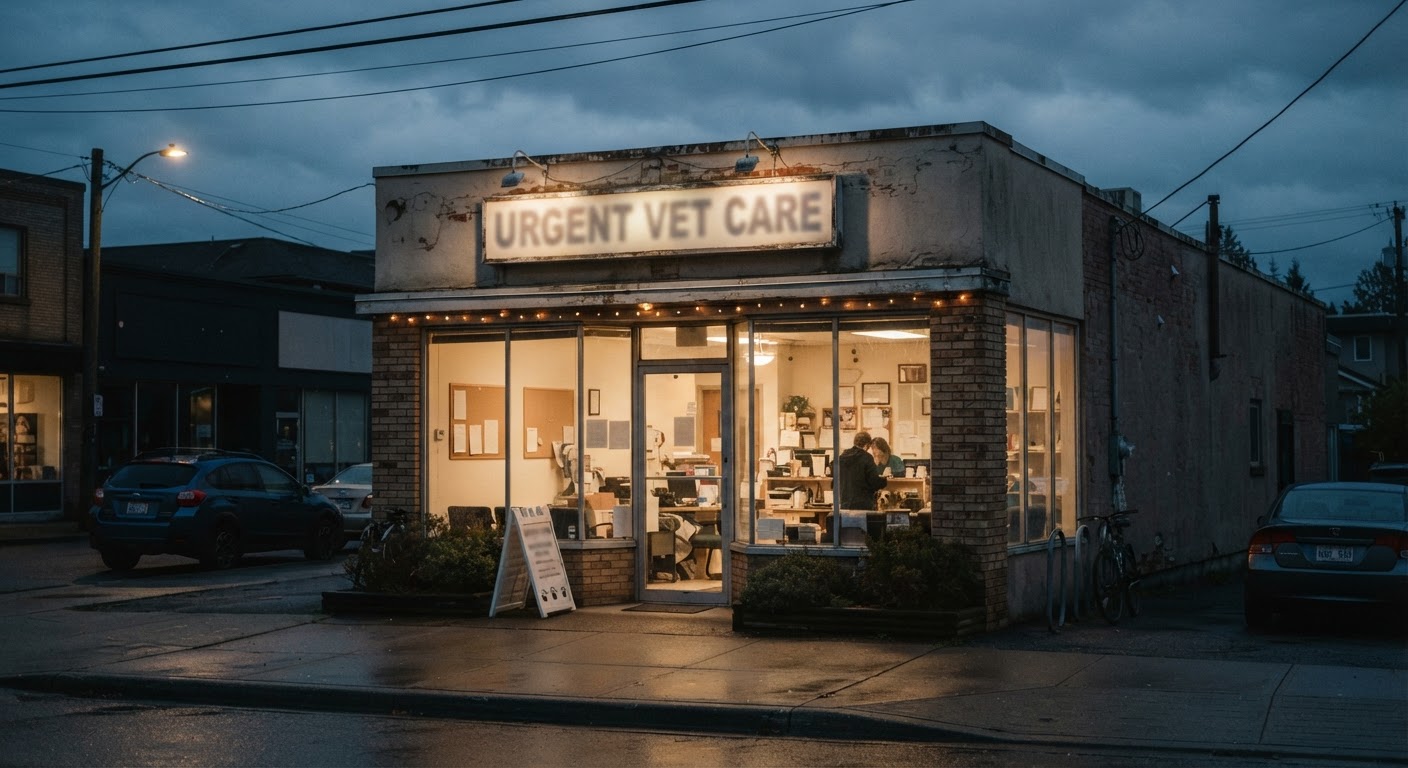
An urgent care vet clinic is built for problems that are uncomfortable and worrying but not immediately life-threatening. Think vomiting that’s lasted a day, a limp with no obvious deformity, a minor cut that needs cleaning and maybe a few stitches, an ear infection that’s clearly painful, or a skin issue that’s flared up fast. These clinics typically keep extended evening or weekend hours, are staffed by a general practice veterinarian rather than a boarded emergency specialist, and have basic diagnostic tools on site: X-ray, bloodwork, maybe ultrasound. They’re not usually equipped for surgery beyond simple procedures, and they don’t have the staffing to monitor a critically ill animal overnight.
A 24-hour emergency animal hospital is a different animal entirely (pun intended). These facilities are staffed around the clock with veterinarians trained specifically in emergency and critical care, often alongside veterinary technicians who can run advanced monitoring equipment. They have the capacity for immediate surgery, blood transfusions, oxygen therapy, and overnight ICU-level observation. Many are affiliated with or function as specialty hospitals, meaning a cardiologist, neurologist, or surgeon might be on call or on staff. This level of readiness is exactly what you want if your pet has been hit by a car, is struggling to breathe, has collapsed, or is bleeding heavily. It’s also exactly why the overhead, and therefore the price, is so much higher.
The practical takeaway is that these two types of facilities aren’t competing versions of the same service. They’re built for different severities of problem, and matching the problem to the right facility is where the real savings and better outcomes come from.
Typical fee structures and price differences between the two
Every clinic sets its own prices, and there’s no single number that applies everywhere, but the pattern across most urgent care and emergency hospitals is consistent enough to plan around.
Urgent care visits generally start with a flat exam or visit fee that’s noticeably lower than an ER’s. From there, add-ons like X-rays, basic bloodwork, wound cleaning, or a course of medication are priced closer to what you’d expect from a regular daytime clinic, sometimes with a modest after-hours surcharge tacked on. The overall visit for something straightforward, a minor wound repair or a diagnostic workup for vomiting, often lands in a range that feels manageable even without insurance, similar to a slightly pricier version of a regular vet visit.
Emergency hospitals, by contrast, tend to charge a much higher upfront triage or exam fee before any treatment even starts. That fee reflects the cost of having a full critical care team on standby 24/7, not the complexity of your pet’s specific case. From there, costs escalate quickly: diagnostic imaging, IV fluids, hospitalization, and any surgery are priced at true emergency-hospital rates, which are built around specialist staffing, expensive equipment, and round-the-clock monitoring. A single overnight stay with monitoring can rival or exceed the entire cost of an urgent care visit, and that’s before any procedures are performed.
The gap between the two isn’t just about the sticker price for a similar service, either. It’s about what gets ordered. Emergency hospitals are trained to rule out the worst-case scenario first, which often means broader diagnostic panels, more imaging, and more conservative decisions about hospitalization, all of which are appropriate for genuinely critical cases but add up fast for something that turns out to be minor. Urgent care clinics, treating a narrower range of less severe problems, tend to run a leaner, more targeted set of tests.
None of this means emergency hospitals are overcharging. Keeping a surgical suite, imaging equipment, and specialist staff available at 3 a.m. is expensive, and that cost gets built into every visit, whether your pet needs all of it or just a fraction. The point is simply that the price difference is real and predictable, so it’s worth knowing which tier you’re walking into before you arrive.
Situations where urgent care is appropriate versus when it isn’t
The hardest part of this whole topic is that in the moment, fear makes everything feel like an emergency. That’s a normal, protective instinct, and it’s not something to feel bad about. But it helps to have a general sense, decided calmly in advance, of what tends to fall into each category, rather than trying to reason it out for the first time while your pet is uncomfortable and you’re stressed.
Urgent care is generally a reasonable fit for problems that are bothering your pet but aren’t rapidly getting worse: a limp without obvious swelling or deformity, mild vomiting or diarrhea that’s been going on for less than a day without other symptoms, a minor cut or scrape, an eye that’s watering or a little red, an ear that smells bad and seems itchy, a small lump that suddenly appeared, or mild allergic reactions like hives or facial swelling that isn’t affecting breathing. These are situations where a same-day or next-morning general practice visit would often be fine too, but urgent care fills the gap when you can’t wait that long and want reassurance sooner.
Signs that point toward a true emergency hospital, not urgent care, include difficulty breathing or blue-tinged gums, collapse or inability to stand, uncontrolled bleeding, repeated vomiting or retching without producing anything (especially in deep-chested dog breeds, where this can signal a life-threatening condition), a distended or hard abdomen, seizures, suspected poisoning, a bite wound that’s deep or from a larger animal, being hit by a car or falling from a height, straining to urinate with no output (especially in male cats, where this can become critical fast), or any sudden, severe change in behavior or consciousness. In these situations, the extra cost of a full emergency hospital isn’t a luxury, it’s the only setting equipped to actually stabilize your pet in time.
If you’re ever genuinely unsure which category you’re in, most urgent care clinics and emergency hospitals have a phone line for exactly this reason. Calling ahead and describing what you’re seeing costs you nothing and can save you from either overpaying at an ER for something minor or, worse, underestimating something serious because you wanted to save money. When in real doubt, err toward the higher level of care and let the professionals downgrade the urgency, not the other way around.
How triage and wait times affect cost and outcomes
One thing that surprises a lot of pet owners the first time they visit an emergency hospital is that arrival order doesn’t determine treatment order. Emergency hospitals triage the way human ERs do: the most critical animals are seen first, regardless of who got there first. That means a stable pet with a minor issue might sit in a waiting area for a long stretch of time while sicker animals are treated, and that wait can stretch into hours during busy periods, especially nights and weekends.
This matters for your wallet in a couple of indirect ways. Longer waits sometimes mean owners request additional diagnostics just to feel like something is happening, or the stress of a long wait pushes people toward agreeing to more testing than they might otherwise, simply to get answers and go home. It also means that if your pet’s issue truly is low-urgency, you may be paying emergency-hospital pricing for a visit that, time-wise, played out a lot like a routine appointment anyway.
Urgent care clinics, dealing with a narrower band of severity, tend to have shorter and more predictable wait times, which is part of why they exist. You’re less likely to be sitting behind a genuine crisis case, so the visit is often faster from arrival to discharge.
Wait times also intersect with outcomes in a way worth naming plainly: for genuine emergencies, time matters medically, not just financially. A condition that’s manageable in its early stages can become more complicated, and more expensive to treat, the longer it goes untreated. This is part of why choosing the correctly matched level of care isn’t only about saving money on the visit itself. Sending a truly critical pet to urgent care because it’s cheaper can backfire if that clinic isn’t equipped to handle what’s actually going on, leading to a transfer to an emergency hospital anyway, except later, after time has already been lost.
How insurance treats claims from each type of facility
Most pet insurance policies don’t discriminate based on the type of facility, urgent care and emergency hospitals are typically both covered under the same accident and illness benefits, as long as the visit is for a covered condition and you’re past any waiting period. The claims process usually works the same way regardless of where you were treated: you pay the clinic at the time of service, submit the itemized invoice and any records to your insurer, and get reimbursed a percentage of the eligible costs based on your plan’s reimbursement rate and deductible.
The higher price tag at emergency hospitals doesn’t automatically mean a higher reimbursement rate, it just means a higher total bill, so your standard percentage applies to a bigger number. This is one of the more practical reasons to understand your plan’s annual limit before an emergency happens. If your policy caps annual payouts, a single major emergency hospital visit could use up a meaningful chunk of that limit in one trip, whereas the same underlying issue treated conservatively at urgent care might not.
Deductibles matter here too. If you have an annual deductible that resets each policy year, an emergency hospital bill is more likely to clear that deductible in a single visit, meaning reimbursement kicks in sooner within that visit than it might for a smaller urgent care bill that could fall entirely under the deductible.
It’s also worth checking, ahead of time, whether your specific policy has any exclusions or waiting periods tied to emergency care, or whether certain diagnostics common at ERs (like advanced imaging) fall into a different reimbursement category than routine care. These details vary by insurer and by plan tier, so reading your policy’s fine print on facility type and diagnostic coverage before you’re standing in a waiting room is far easier than trying to parse it while you’re worried about your pet.
Building a personal decision checklist before an emergency happens
The best time to figure out where you’re going in a crisis is not during the crisis. A short amount of preparation now can save you both money and precious time later.
Start by identifying, in your area, which clinics function as urgent care and which are true 24-hour emergency hospitals. Save their phone numbers and addresses somewhere you’ll actually find them under stress, a notes app, a magnet on the fridge, a card in your wallet. Note their hours, since some urgent care clinics only operate certain evenings or weekend blocks and revert to closed at other times.
Write down, in plain language, the short list of symptoms that mean “go straight to the emergency hospital, don’t call around first.” Keep it simple enough to read in a panic: trouble breathing, collapse, uncontrolled bleeding, repeated unproductive retching, seizures, suspected poisoning.
Know your insurance policy’s basics cold: your deductible amount, your reimbursement percentage, your annual limit, and whether there’s any waiting period still in eff