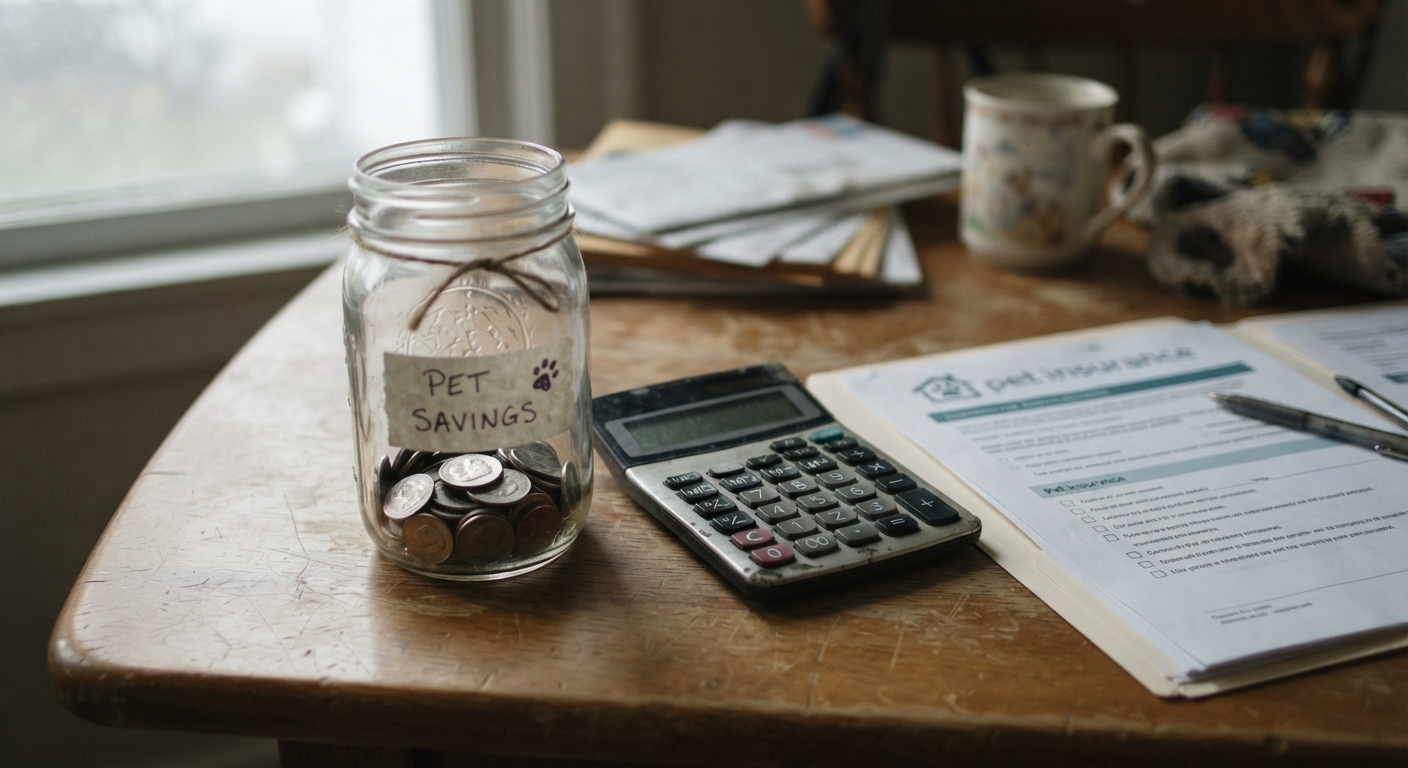
If you’ve ever paid a vet bill that made your stomach drop, you’ve probably wondered whether there’s a smarter way to prepare for the next one. Two strategies keep coming up: pet insurance, where you pay a monthly premium and file claims when something goes wrong, and self-insuring, where you set aside your own money in a dedicated savings account and skip the insurance company altogether. Both can work. Both can also leave you exposed if you don’t understand how they actually behave over time. Here’s a grounded look at each, so you can pick the one that fits your household rather than the one that sounds best in theory.
How a dedicated pet savings account works in practice
The idea behind a pet savings account is simple: open a separate savings account, name it something like “Vet Fund,” and put money into it every month instead of paying an insurance premium. Over time, that account grows, and when your dog eats something he shouldn’t have or your cat needs dental work, you pull from the account instead of your emergency fund or a credit card.
The appeal is obvious. There’s no monthly premium going to an insurance company, no exclusions to memorize, and no waiting periods. Every dollar you put in is yours, and if your pet stays healthy for years, that money is still sitting there, earning a little interest, available for anything you want it for.
In practice, though, a pet savings account only works if you treat it with real discipline. That means automating a transfer every payday, the same way you’d automate a premium payment, rather than telling yourself you’ll “add to it when things are tight.” It also means genuinely not touching it for anything other than veterinary care. A pet fund that quietly gets raided for a car repair or a rough month of groceries isn’t really a pet fund anymore, it’s just your checking account with an optimistic label.
How monthly insurance premiums compare to steady self-funded savings
Insurance and self-funded savings look similar on the surface, since both involve setting money aside on a regular basis. The difference is what that money is doing while it sits there.
With insurance, your monthly premium is pooled with the premiums of thousands of other pet owners. That pooling is what lets an insurer pay out a claim that’s far larger than any single month’s premium, even if your pet has only been covered for a short time. You’re paying, in part, for other people’s bad luck in exchange for coverage against your own.
With self-funded savings, there’s no pooling. The only money available to you is the money you personally put in. If you’ve been saving for two years and build up a solid cushion, a self-funded account can comfortably absorb a mid-sized bill. But if a major illness or injury happens early, before the account has had time to grow, there’s simply less there to draw on. Insurance is designed to smooth out that timing problem. A savings account is not, unless you fund it aggressively from day one.
There’s also a behavioral difference worth naming honestly. A premium payment is money that leaves your hands and is gone, which for many people makes it easier to keep paying consistently. A savings account is money that’s still technically yours and still visible in your bank app, which for some people makes it easier to skip a deposit “just this once.” Neither tendency is a character flaw, but it’s worth being honest with yourself about which one describes you.
The math: what a large unexpected bill looks like under each approach
Let’s walk through a hypothetical to make this concrete, using round numbers rather than claiming these represent typical costs, since actual bills vary enormously by animal, region, and situation.
Imagine two pet owners, both with young, healthy dogs. One pays a monthly insurance premium. The other deposits the same dollar amount each month into a dedicated savings account. For the first year, nothing happens, and both approaches look identical: money goes out, nothing comes back.
Now suppose that in month fourteen, both dogs need emergency surgery for a swallowed object, and the bill comes in high, the kind of bill that would strain most household budgets if it showed up out of nowhere. The self-insuring owner has whatever has accumulated in their savings account after fourteen months of deposits, minus nothing, since nothing has been withdrawn yet. If that total is less than the bill, which is common at just over a year of saving, they’re short, and the gap has to come from somewhere else: a credit card, a personal loan, a payment plan through the vet, or borrowing from family.
The insured owner, assuming the condition isn’t excluded and any waiting period has passed, files a claim. After the deductible and the reimbursement percentage are applied, the insurer covers a meaningful share of the bill, often the majority of it, and the owner’s out-of-pocket cost is closer to the deductible and their percentage of the remainder than to the full amount.
Run the same scenario in month sixty instead of month fourteen, and the picture changes. By then, the self-funded account may have grown large enough, especially if it was never tapped for smaller expenses, to cover the bill outright with money left over. Meanwhile, the insured owner has been paying premiums that whole time, and if their pet had no other major claims, that premium money is simply spent, not sitting in an account they control.
This is the core trade-off in a nutshell. Self-funding rewards patience and time; the risk is concentrated in the early years before the account has grown. Insurance smooths out that early risk but costs you money over the long run if your pet turns out to be relatively healthy, since premiums keep going out whether or not you file a claim.
Risks of self-insuring, including timing and account balance gaps
The biggest risk of self-insuring isn’t that it fails as a strategy, it’s that it fails at the worst possible time. Illness and injury don’t wait for your savings account to mature. A puppy or kitten can develop a serious problem in its first year, long before a new pet fund has had a chance to build any real cushion. If that happens, self-insuring hasn’t had the time it needs to work, and you’re left covering the gap out of pocket anyway, which defeats much of the purpose.
There’s a second, quieter risk: the temptation to dip into the account for things that feel vet-adjacent but aren’t true emergencies, like a nicer bag of food or a grooming splurge. Each withdrawal seems small, but they add up, and a fund that gets drawn down gradually never reaches the size it needs to be when a real emergency hits.
There’s also the multi-pet household problem. If you have more than one dog or cat, a single shared savings account has to stretch across all of them. Two pets, two potential emergencies, one pot of money. That’s not necessarily a dealbreaker, but it does mean the account needs to be sized with that reality in mind, not just against a single animal’s likely costs.
Finally, self-insuring puts the entire risk curve on you. There’s no ceiling to how much a serious illness or a specialist referral can cost, and unlike insurance, there’s no pooled backstop absorbing the extreme end of that range. If your dog needs an extended hospital stay or ongoing specialist care, a self-funded account, even a well-managed one, can simply run out.
Situations where insurance tends to outperform saving alone
Insurance tends to look best relative to self-funding in a few specific situations. The first is with young pets, where there hasn’t been time to build savings and where breeds or individual animals can turn up unexpected conditions early in life. Insurance essentially rents you a large pool of coverage before you’ve had time to build your own.
The second is when household cash flow is tight enough that an unexpected bill of any real size would have to go on a credit card or a loan regardless of how much is in a savings account. In that situation, the predictability of a monthly premium, and the protection it offers against the tail-end costs of a serious illness, can matter more than the theoretical long-run savings of self-funding.
The third is for conditions that are expensive to manage over a long stretch of time, such as ongoing treatment for a chronic illness, extended hospitalization, or a diagnosis that requires specialist care. These are exactly the scenarios where a self-funded account is most likely to be outpaced by the size of the bills, and where the pooled structure of insurance does the most work on your behalf.
Insurance also tends to make more sense for owners who know themselves well enough to recognize that a savings account earmarked for the pet will quietly get treated as flexible money. If that’s a realistic description of your habits, a monthly premium that leaves your account automatically may protect you better than a balance you can see and are tempted to use.
A hybrid approach: using both together
You don’t actually have to choose one or the other, and a lot of financially savvy pet owners end up doing both, just at a smaller scale than either approach alone.
One common version: carry an insurance policy with a moderate deductible, and keep a smaller dedicated savings account sized specifically to cover that deductible plus routine costs insurance typically doesn’t touch, like regular checkups, vaccinations, or dental cleanings. In this setup, the savings account isn’t trying to cover an entire emergency surgery on its own, it’s just there to handle the predictable, smaller costs and your share of the bigger ones. That’s a much easier target to hit than trying to fully self-fund every possible scenario.
Another version: choose a higher deductible on the insurance policy, which usually lowers the monthly premium, and put the difference between that lower premium and what a lower-deductible policy would have cost into a savings account. That account then exists specifically to cover the deductible if a claim comes in, so you’re never caught short when the bill and the claim form arrive at the same time.
The hybrid approach tends to appeal to people who like the predictability of insurance for the worst-case scenarios but don’t want to feel like they’re paying premiums for years with nothing to show for it if their pet stays healthy. It takes a bit more organization than picking one lane, but it also spreads the risk in a way that neither strategy does entirely on its own.
Questions to ask yourself before choosing a strategy
Before settling on an approach, it helps to answer a few honest questions about your own situation rather than trying to find a universal right answer, because there isn’t one.
How old is your pet right now, and how much time would a savings account realistically have to build up before a major bill could plausibly show up? A senior dog or cat gives you far less runway than a young one.
How would your household actually absorb a large, unexpected bill today, this month, if it landed on you before any savings account had time to grow? If the honest answer involves a credit card with a high interest rate, that’s useful information about how much protection you need in the meantime.
Do you trust yourself to leave a dedicated savings account alone, month after month, even when other expenses are pulling at your budget? Some people genuinely do. Others find that money “in the bank” is money that gets spent eventually, on something.
Do you have more than one pet, and if so, does your plan account for the possibility of two emergencies rather than one? And finally, is your current budget better suited to a predictable